Every video that crosses a language border faces the same question early on. Should the audience read the translation or hear it? Subtitles and voice over both solve the problem, but they do it in very different ways, at different costs and with very different results for the viewer.
There is no universal winner. The right format depends on the content, the audience, the platform and the budget, and getting that choice right before production starts saves money and frustration later.
What subtitles do well
Subtitles keep the original performance intact. Viewers hear the real voices, the emotion and the pauses, while the translation sits quietly at the bottom of the screen. For films, documentaries and interviews, this authenticity is often the main argument.
Subtitles are also faster and cheaper to produce. A skilled subtitler can translate and time a short corporate video in a day or two. There is no studio, no casting and no mixing session. Files are light, easy to update and simple to deliver in several languages at once.
They also improve accessibility. Many people watch with the sound off, on phones, in public transport or in open-plan offices. Viewers who are deaf or hard of hearing rely on captions completely. The W3C guidance on accessible audio and video explains why captions and transcripts matter for anyone publishing media online.
Where subtitles struggle
Reading takes attention. When a video is visually dense, such as a software tutorial, a safety demonstration or a fast-paced product launch, viewers cannot read and watch at the same time. Something gets missed.
Subtitles also have strict space limits. Usually two lines of around 40 characters, shown for only a few seconds. Dense technical speech has to be condensed heavily, and some detail is inevitably lost. For training content where every instruction counts, this can be a real problem.
Finally, some audiences simply prefer to listen. Children, older viewers and people with lower literacy levels often find subtitled content tiring.
What voice over brings
Voice over replaces or overlays the original speech with a recorded translation. The viewer can keep their eyes on the screen. Instructions, demonstrations and visual storytelling become easier to follow.
There are several styles:
- UN-style voice over, where the original voice is heard briefly and then lowered under the translation, common in news and documentaries
- Narration, where a single voice tells the story over images, ideal for corporate films and explainer videos
- Lip-sync dubbing, where actors match the mouth movements on screen, used for feature films, animation and series
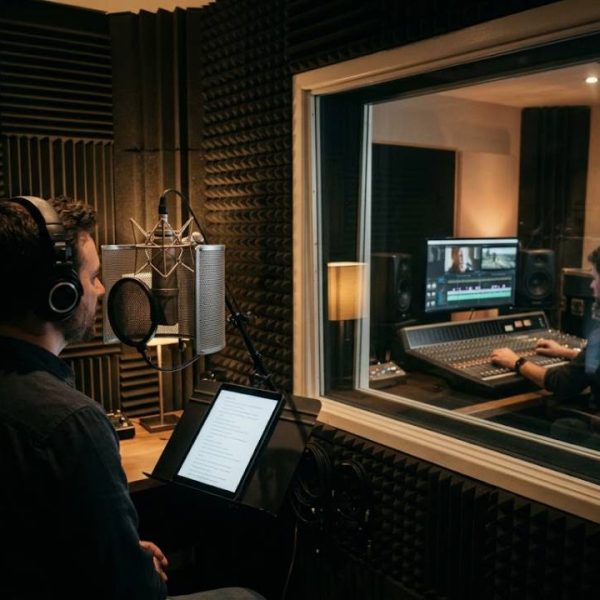
Professional voice over services combine translation, adaptation of the script to the timing, casting of native voice talent and studio recording. The result feels local, as if the video had been made for that market from the start.
The trade-offs of voice over
Voice over costs more. It involves translators, script adapters, voice actors, sound engineers and often a director. Turnaround times are longer, and every later change to the video may mean another recording session.
It can also feel less authentic if done badly. A flat, generic voice over a passionate interview loses the energy of the original speaker. Casting is half the battle. The voice has to fit the age, tone and personality of the person on screen or the brand behind the video.
A simple way to decide
Producers and marketing teams can use a few questions to guide the choice:
- Is the original voice part of the value? Interviews, testimonials from real customers and artistic films usually work better with subtitles.
- Do viewers need to look at details? Tutorials, e-learning and safety training usually work better with voice over.
- Where will the video play? Social media favours subtitles, because most clips start muted. Television and cinema audiences in many countries expect dubbing.
- How often will the content change? Frequently updated videos are easier to maintain with subtitles.
- What does the market expect? Germany, France, Italy and Spain have strong dubbing traditions, while the Nordic countries and the Netherlands prefer subtitles.
Why many projects use both
The choice is not always either or. Many companies record a voice over for their main training modules and add subtitles for accessibility. Streaming platforms offer dubbed audio tracks and subtitle files side by side. Marketing teams often release a dubbed version for paid campaigns and a subtitled cut for organic social posts.
Video is only one part of a wider campaign, and the same planning mindset applies to the rest of the content. Agencies that coordinate campaigns across several markets increasingly build their workflows around AI-assisted drafting and human review, an approach explored in this guide to marketing translation services for agency teams. Thinking about format, script and translation together keeps every version of a campaign consistent.
Combining formats is easier when the workflow starts with a clean script. That usually means an accurate audio and video transcription of the source, with time codes and speaker names. From that single document, translators can produce both the subtitle file and the voice over script, keeping terminology consistent across versions.
Quality checks that matter
Whatever the format, quality control is essential. For subtitles, a reviewer should watch the full video with the file loaded, checking timing, line breaks and reading speed. For voice over, the final mix should be reviewed for pronunciation of names and brand terms, sync with on-screen action and audio levels.
It is also worth testing with real viewers from the target market. A short review by a native speaker who has never seen the project often reveals problems the team has stopped noticing.
The bottom line
Subtitles respect the original and keep budgets lean. Voice over makes content effortless to follow and feel truly local. The best choice comes from understanding the audience and the purpose of each video. Teams that make this decision early, and plan the script and workflow around it, end up with multilingual videos that are watched to the end instead of skipped after ten seconds.