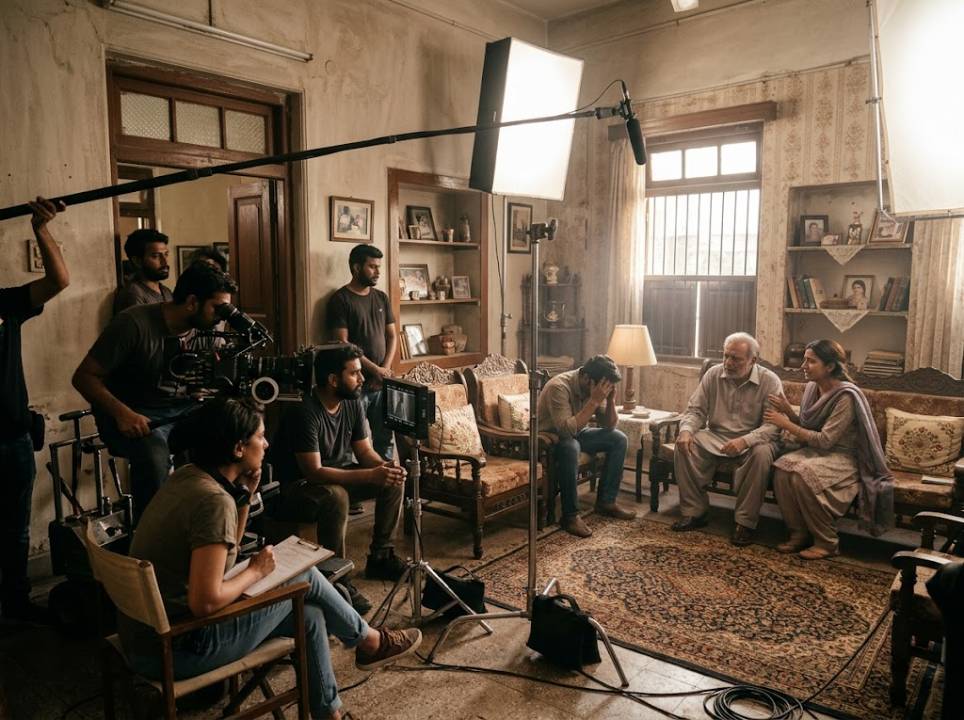
Pakistani television dramas have built a loyal audience far beyond Pakistan. Viewers in the UK, the Gulf, North America, India and even Turkey follow long family sagas, romantic stories and social dramas, often on YouTube or streaming platforms. Many of these viewers grew up abroad and understand spoken Urdu only partly, while others do not speak it at all. Subtitles open these stories to all of them.
The opposite direction matters too. Global films, documentaries and online courses are increasingly subtitled into Urdu for audiences in Pakistan and the diaspora. In both cases, subtitling with Urdu requires special skills.
A language with a rich literary tradition
Urdu is the national language of Pakistan and one of the official languages of India. It is written in the Perso-Arabic Nastaliq script, from right to left, and draws vocabulary from Persian, Arabic and Sanskrit-derived roots. Its history and features are well summarised in the encyclopaedia entry on Urdu.
Urdu is also a language of poetry. Dramas often include verses, songs and elegant expressions that carry emotional weight. Translating these moments flatly into English strips scenes of their feeling. A skilled subtitler finds wording that keeps some of the rhythm and beauty while staying readable.
Urdu to English: the main challenges
- Forms of address such as aap, tum and tu show respect, closeness or anger
- Family terms distinguish maternal and paternal relatives in ways English does not
- Religious and cultural expressions appear naturally in everyday speech
- Poetry and song lyrics need careful, often creative, rendering
- Code switching between Urdu and English is common in modern dialogue
Each of these requires choices. Should khala become "aunt" or stay as is? Should a respectful aap be shown through more formal English? Consistent decisions, recorded in a series glossary, keep the viewing experience smooth.
English to Urdu: technical points
Subtitling into Urdu brings technical challenges. Right-to-left text must display correctly on every platform and device. Nastaliq script is beautiful but needs good font support, and some players fall back to simpler Naskh fonts. Punctuation, numbers and mixed English terms inside Urdu lines must be handled carefully so that the line order does not break. Testing the files on the actual delivery platform is essential.
Standard subtitling rules still apply
Whatever the direction, subtitles follow familiar rules: a maximum of two lines, a comfortable reading speed, timing aligned with speech and shot changes, and line breaks that respect meaning. Long, emotional monologues are common in dramas, so subtitlers must condense without losing the core of each speech.
Finding the right translator
A professional Urdu subtitler combines fluent Urdu and English, cultural knowledge of Pakistan and the diaspora, and experience with subtitling software. For films and dramas, an ear for dialogue and emotion is just as important as grammar. For corporate and educational videos, accuracy of terminology comes first.
Agencies with a wide network can match each project to the right profile. PoliLingua works with experienced linguists, and every urdu translator on its team translates into their native language, covering subtitles, scripts, marketing material and official documents.
The diaspora audience
Many viewers of Pakistani dramas abroad are second or third generation. They understand family conversations but miss formal Urdu, poetry or regional expressions. For them, English subtitles are a bridge back to the language of their parents and grandparents. Subtitles that keep cultural terms where they matter, while making the meaning clear, respect both the story and this audience.
The same bridge matters outside entertainment. Urdu speakers in California rely on clear communication at medical appointments, school meetings and public offices, where subtitles cannot help in the moment. Providers of interpreting services support those live conversations so that families are not left to guess at important details. When written translation and live interpreting work together, diaspora communities can take part fully in local life.
Corporate, health and education content
Beyond entertainment, Urdu subtitles help public health campaigns, NGOs, universities and companies reach communities in Pakistan and abroad. A vaccination video, a workplace safety course or a university lecture in Urdu can make a real difference. Here, clarity and correct terminology matter more than style, and review by a subject expert is recommended.
Machine translation and Urdu
Automatic translation for Urdu has improved but remains weaker than for major European languages. Speech recognition struggles with fast dialogue, poetry and code switching. Machine output can be a starting point for rough internal use, but published subtitles need full human translation or thorough post-editing.
Quality control
Before release, subtitles should be checked in real time with the video, on the target platform. Reviewers look at timing, readability, right-to-left display for Urdu files, spelling and consistency of names. Songs and on-screen text, such as phone messages or signs, must not be forgotten.
Planning a subtitling project
Share scripts if they exist, a list of character names and any previous episodes already subtitled. Agree on the treatment of honorifics, songs and cultural terms at the start. Clarify the file format and platform requirements. With these basics in place, even a long series can be subtitled efficiently and consistently.
The bottom line
Urdu stories deserve to be understood wherever their audience lives. Professional Urdu subtitling preserves emotion, poetry and cultural meaning while meeting strict technical standards. With an experienced translator, a drama from Lahore can move viewers in London, Dubai and Toronto just as much as at home.